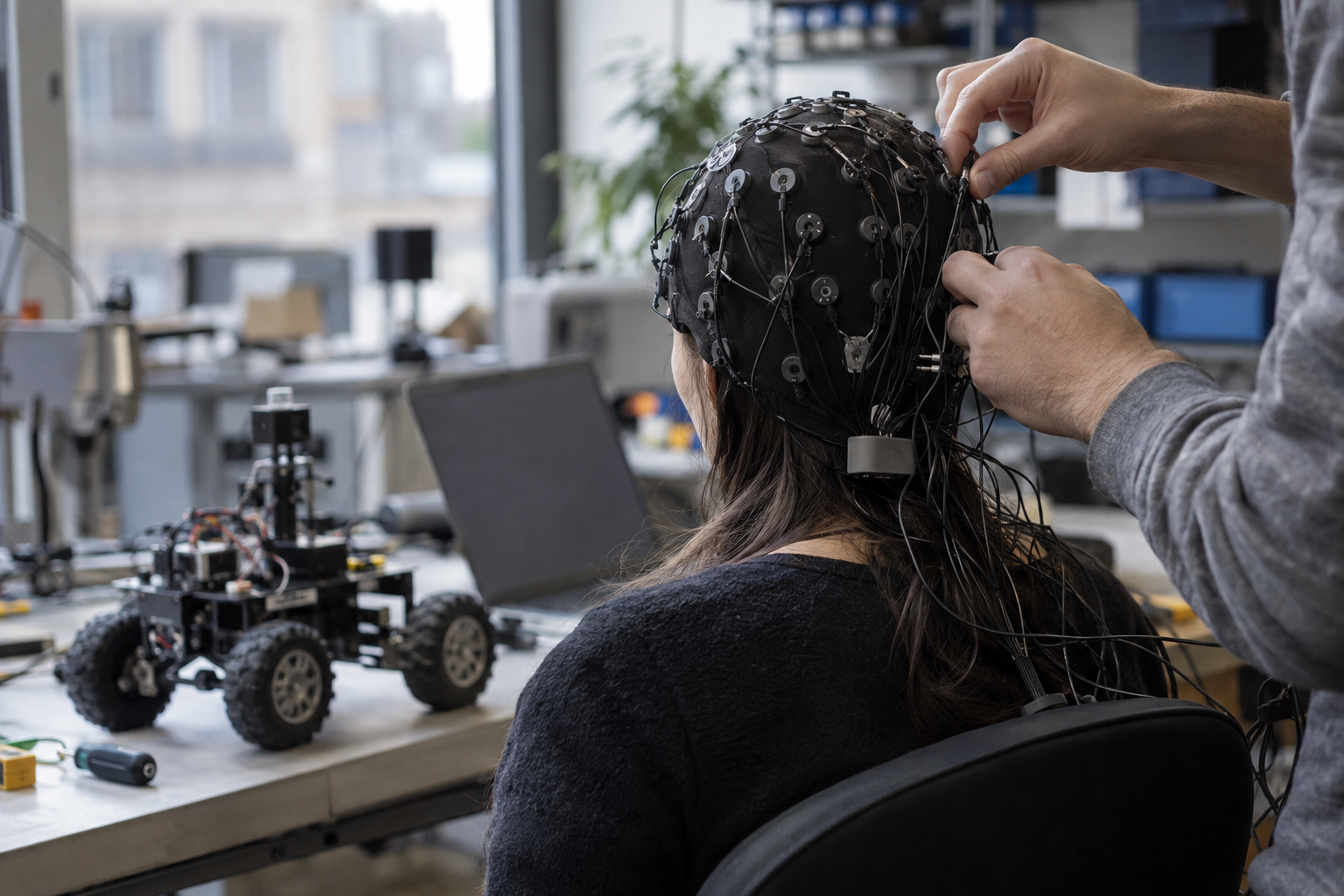
Cerebionics takes brain-computer controls into Ukrainian military testing
Cerebionics has spent months testing and refining its brain-computer interface with Ukrainian soldiers across different parts of the military, Tech.eu reports. The startup is exploring defence applications for a non-invasive platform that translates brain activity into machine commands, bringing prospective users into development rather than relying solely on laboratory work.
Founded by Norwegian engineer Agnessa Pedersen, Cerebionics is developing a modular system intended to connect to drones, unmanned ground vehicles and command-and-control software interfaces. According to Tech.eu, the platform uses electroencephalography, or EEG, electrodes to capture electrical activity and is designed to be light and portable enough for use on the move.
The technology can already support broad directional commands, with Cerebionics working to increase the number of instructions it recognises. It is not attempting to reconstruct every physical movement an operator would make with a conventional controller. Instead, it identifies patterns associated with an intended action and passes a higher-level instruction to another system.
The work remains developmental. At the time of Pedersen’s interview with Tech.eu, Cerebionics had not completed a model that could readily transfer between users and applications. Onboarding and calibration could take around an hour in a favourable case involving someone who quickly understood how to use the interface.
Tech.eu withheld much of the detail about the Ukrainian military work. The reporting therefore establishes hands-on testing with potential users, rather than a disclosed commercial deployment. For a company seeking a foothold in defence, that distinction separates evidence of operational engagement from evidence of a market-ready product.
A London team built around non-invasive EEG
Pedersen began working on Cerebionics in 2024 while studying full-time, she told Tech.eu. She moved into the business full-time after Project Europe became involved, roughly a year before the interview, then relocated to London and assembled the team. The source does not give a funding amount or terms for Project Europe’s involvement.
Her route into the business began with building robotic arms as a teenager, initially to help produce large drawings. Pedersen learnt Python and C++ through online courses, including Udemy, before studying an integrated engineering master’s specialising in cybernetics and robotics. That training brought together control theory, software, electronics and mechanical engineering.
Early experiments with flex-sensor gloves helped define the problem she wanted to solve. Such wearables responded to physical execution, whereas Pedersen wanted to capture the intention preceding movement. According to Tech.eu, that distinction drew her towards interfaces that could reduce dependence on bodily controls rather than simply instrument them.
Cerebionics’ approach differs from Neuralink’s implanted technology. Tech.eu explains that Neuralink uses thousands of electrodes placed directly in brain tissue to obtain higher-resolution signals for people with severe conditions, including quadriplegia and locked-in syndrome. Non-invasive EEG receives weaker signals through the skull, limiting the detail Cerebionics can decode but avoiding an implant.
The European competitive landscape includes several distinct approaches. UK-based Cogitat develops hardware-independent AI software for interpreting EEG, including for robotic rehabilitation. Latvia’s BirgerMind is developing non-invasive interfaces to help people with severe motor impairments communicate and operate digital devices. Switzerland’s Neurosoft Bioelectronics is developing soft electrodes that access the cortex without penetrating brain tissue, Tech.eu reports.
Other companies are targeting different information from the brain. Sweden’s InnoBrain combines EEG, eye tracking and AI to interpret cognitive and emotional states, including for operator monitoring. The range of applications matters commercially: neurotechnology companies may compete over particular customer needs without offering equivalent sensing methods or levels of machine control.
Pedersen sees an additional control channel, not a universal replacement
Pedersen’s case for brain-computer interfaces is that they can complement muscle sensors, speech and eye tracking, rather than make those technologies redundant. She told Tech.eu that different control methods have different strengths. The intended opportunity is another route for communicating decisions when existing interfaces are unsuitable or already occupied.
One encounter in Ukraine gave that proposition a practical context. Pedersen described meeting a veteran who had operated first-person-view drones before losing most of his right hand in combat. He wanted to continue contributing but could no longer use the controls as before. The account illustrates a potential accessibility need; it does not establish that Cerebionics restored his ability to fly.
Pedersen also outlined why decoding requires individual calibration. Brain-activity patterns vary between people and can change from day to day, she told Tech.eu. Cerebionics examines event-related desynchronisation and activity in different brain areas, drawing on similarities between the signals associated with performing an action and imagining it.
Distinguishing deliberate instructions from background activity is another central requirement. Pedersen said Cerebionics had trained models to separate noise from intended commands and emphasised the need for safeguards that prevent action when confidence is low. That makes reliable rejection of uncertain signals part of the product challenge, alongside recognising valid instructions.
Pedersen regards current sensing hardware as sufficient for development; the greater difficulty is software that can decode signals consistently and work across users. She also argued that systems costing $20,000 or $100,000, with extensive data-collection requirements, would not support mass adoption. Those figures describe barriers she wants to avoid, not announced Cerebionics prices.
Broader command support and faster setup shape the next stage
Cerebionics’ stated development priorities include extending its command repertoire and making onboarding and calibration much faster. Pedersen expects a more transferable model to help achieve that, according to Tech.eu. The report gives no firm completion date, leaving the timing of that technical milestone open.
Affordability is a separate goal. Pedersen wants the overall system cost to move towards that of conventional controllers, whose prices vary considerably. She also said large-scale adoption would require performance at least comparable with existing interfaces, straightforward setup and training demands that do not run into hundreds of hours.
Future packaging could include a standalone wearable, such as headwear, or integration into equipment people already use, including smart glasses and goggles. Tech.eu identifies healthcare, consumer products and industry alongside defence as possible application areas. These are prospective markets and formats, not confirmed product launches or expansion agreements.
For operational users, response speed will depend on more than Cerebionics’ decoder. Tech.eu notes that the full chain includes signal capture, classification, transmission and execution by the receiving machine. Communications jamming could interrupt a drone connection even if the brain-computer interface itself worked correctly, making network and equipment compatibility important to deployment.
Pedersen’s longer-term defence ambition is to help operators interact with multiple systems more effectively. Her experience in Ukraine also points to the limits of treating a country as one uniform testing environment: she told Tech.eu that conditions differ substantially between the eastern and southern fronts. For technology businesses expanding from the UK into European defence applications, the practical implication is that local access alone is not enough; development must account for the specific environments in which customers will operate.