
Market Intelligence & Trends
EU supply chain rules strengthen case for shared checks
Assessments taking 31 minutes or several hours expose a data-readiness gap as brands face growing demands for evidence about their supply chains.
08 Nov

The daily brief on companies, capital and policy moving into the UK and Europe.
Europe’s reliance on overseas chips, cloud services and AI models is sharpening the case for supplier choice rather than complete technological self-sufficiency.

By Tomás Ferreira, Europe Correspondent · Berlin
25 October 2026 · Reported from Maddyness UK
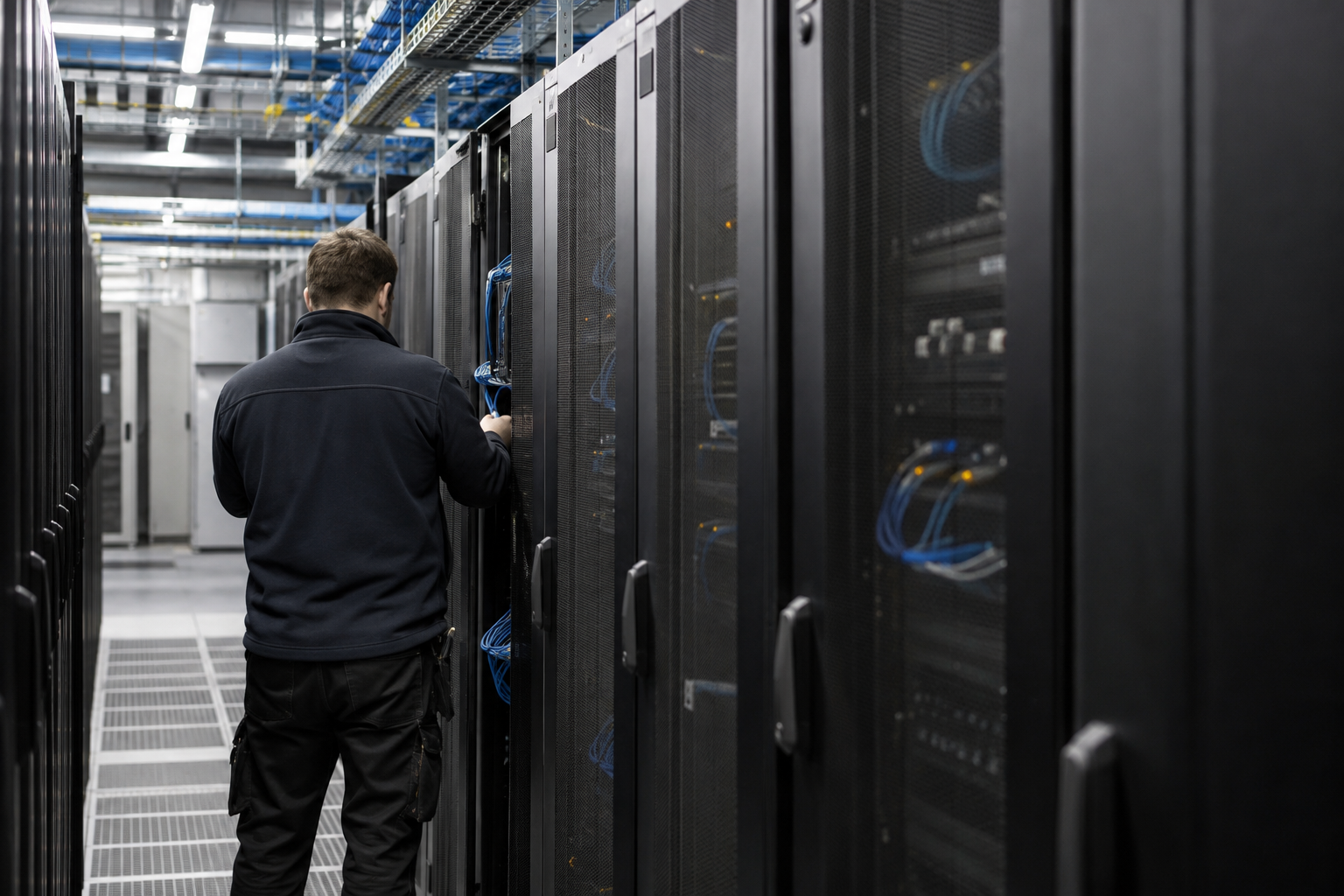
Europe’s drive for greater control over artificial intelligence faces a concentrated supplier market: AWS, Microsoft Azure and Google Cloud together hold around 70% of European cloud business, according to Maddyness UK. The challenge extends beyond building competitive AI models to securing access to the infrastructure that makes them usable.
Europe accounts for just 5% of global data centre capacity, compared with approximately 75% in the United States and 15% in China, Maddyness UK reports, citing Andrea Renda, research director at Brussels-based think tank CEPS. Those proportions put the continent’s infrastructure constraints at the centre of the sovereignty debate.
Maddyness UK describes a disruption that exposed the risks of relying on foreign-controlled technology. According to its report, Washington required US startup Anthropic to withdraw foreign nationals’ access to its most powerful AI models in June on national security grounds. The European Union regained access in September following several months of negotiations. Anthropic makes Claude, which the outlet describes as widely used in Europe.
The supply chain begins well before software development. China accounts for around 60% of rare earth extraction and 90% of refining, according to International Energy Agency figures cited by Maddyness UK. These materials are needed to manufacture electronic components, placing an important upstream resource outside European control.
Chip production presents another constraint. Maddyness UK reports that the European Union makes less than 10% of the world’s semiconductors and does not produce the most advanced graphics processing units used for AI. The report identifies US groups Nvidia and AMD and Taiwan’s TSMC among the small number of companies central to advanced chip design and manufacturing.
Europe nevertheless holds a significant position in the equipment used to produce those chips. Dutch company ASML is a leading supplier of chipmaking machinery, Maddyness UK notes. Its role gives Europe an important industrial strength within an otherwise heavily international production system.
The model market adds a further layer of dependence. France’s Mistral and Germany’s Black Forest are among Europe’s promising AI businesses, but the most advanced technology remains concentrated among US companies OpenAI, Anthropic, Meta and Google DeepMind, alongside China’s DeepSeek. Maddyness UK cites research from economic think tank Rexecode linking that concentration to the substantial cost of development.
Brussels has launched investment programmes targeting areas including critical minerals and semiconductors, according to Maddyness UK. These initiatives address different parts of the same supply chain, rather than treating European ownership of an AI developer as sufficient evidence of technological independence.
Forrester analyst Dario Maisto frames sovereignty as protection against another government’s ability to determine whether an organisation can use essential technology. In comments to AFP carried by Maddyness UK, he argues that foreign jurisdictions should not have final authority over access to data, infrastructure or technological capabilities. That definition makes legal exposure as relevant as where a supplier has its headquarters.
A Forrester report published in July argues that complete sovereignty is unattainable even for China and the United States, Maddyness UK reports. Its recommendation is to strengthen autonomy instead. Maisto’s practical test is whether an organisation has alternatives and can change providers during a crisis, rather than remaining dependent on one supplier.
Sylvain Duranton of consulting firm BCG also rejects an exclusively European technology stack as the goal. His position, reported by Maddyness UK, is that Europe can improve its capabilities without shutting out overseas products. That approach leaves room for European businesses to buy internationally while managing the resulting dependencies.
Duranton describes one way companies already put that approach into practice: using data platforms that provide access to commercial AI models from Europe, China and the United States. According to Maddyness UK, businesses select models through these platforms to match particular requirements, rather than committing every application to the same developer.
For more sensitive work, companies and governments may instead run models on their own servers, Duranton explains in the report. He and Maisto favour assessing sovereignty on a spectrum, with the level of control depending on the activity. Defence is singled out as a sector requiring particularly close scrutiny.
For companies entering European markets, the distinction between supplier nationality and operational control creates a practical procurement question: what happens if access is withdrawn? The analysis reported by Maddyness UK points towards examining replacement options, hosting arrangements and exposure to foreign government decisions before making an AI service indispensable to an operation. These are implications of the dependency risks described, not new regulatory requirements.
The sector-specific approach also has consequences for AI vendors seeking European customers. A business selling into sensitive applications may need a different deployment proposition from one serving less sensitive commercial workloads. The reported preference for running some models on customers’ own servers makes deployment flexibility relevant to market entry, alongside the capabilities of the model itself.
Physical expansion provides a separate part of the market picture. Market Entry Wire has reported on Modal Labs raising $750m after opening a London office. For businesses evaluating the UK, a local office and control over the technology supply chain remain distinct considerations; a presence in the market does not by itself resolve the jurisdictional risks identified by Maisto.
Duranton also argues that Europe must sell more of its own technology abroad, according to Maddyness UK. His reasoning is that influence grows when other economies depend on European capabilities too. For European AI suppliers, that places international sales alongside domestic investment as a route towards a stronger position in the global technology market.
For companies entering the UK or Europe, AI procurement is also a decision about continuity, deployment and legal exposure. The dependencies described by Maddyness UK make it important to distinguish a supplier’s local presence from control over the services it provides. Buyers can assess whether essential workloads have credible alternatives, while vendors can consider which customers need more controlled hosting arrangements. The commercial opportunity is to offer useful AI with deployment options suited to each sector’s sensitivity.
Source
Original reporting by Maddyness UK. This report was written independently for Market Entry Wire.
Assessments taking 31 minutes or several hours expose a data-readiness gap as brands face growing demands for evidence about their supply chains.
08 Nov

Europe’s proposed MEDIA+ budget would more than double existing funding, but national financing rules and territorial rights still constrain cross-border releases.
07 Nov

Circana figures reported by Cosmetics Business show European prestige body care gaining ground as brands bring facial skincare ingredients into body treatments.
05 Nov

Dutch agrifood biotech could generate €17bn more a year by 2040, but Invest-NL warns that approval delays and funding gaps could push growth overseas.
30 Oct

Online retailers face fines of up to 10% of worldwide turnover for pricing breaches as the CMA presses businesses to disclose compulsory delivery fees upfront.
11 Nov

The Swiss-American startup will develop its banking platform and expand its commercial team across Europe, the Middle East and Africa.
10 Nov

The Oxford spin-out will build demonstrator facilities, recruit staff and expand partnerships for a process that avoids highly hazardous hydrogen fluoride.
05 Nov