
Expansion Funding
Perry AI raises €2m to expand legal platform into US and Asia
Haatch leads the London startup’s seed round as Perry AI targets overseas growth and broader legal support for private equity and venture capital funds.
18 Nov

The daily brief on companies, capital and policy moving into the UK and Europe.
The Belgian healthtech company will develop camera-based monitoring for humanoid robots while pursuing EU medical device certification and overseas approvals.

By Eleanor Marsh, Editor · London
19 November 2026 · Reported from Tech.eu
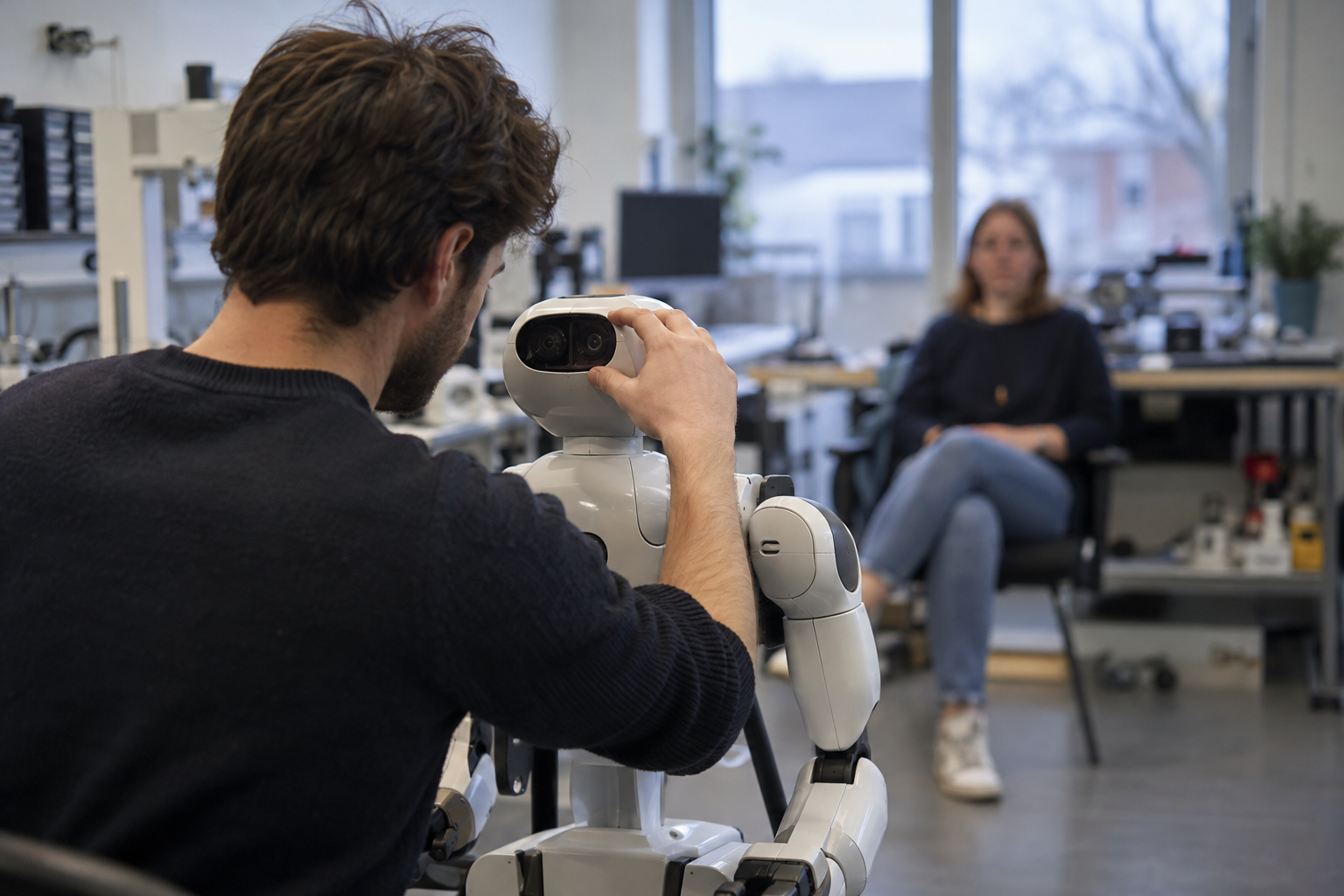
Belgian healthtech company IntelliProve has secured €2.7m in seed funding as it prepares to extend its health-monitoring software into humanoid and assistive robots, Tech.eu reports. Miles Ahead led the investment, joined by Wit-Gele Kruis, imec.istart and several business angels.
The expansion targets a new setting for remote monitoring: robots operating in homes and care facilities. IntelliProve is already working with selected robotics partners, according to Tech.eu, although the report does not identify those developers. Healthcare professionals would remain responsible for medical decisions.
IntelliProve’s existing business supplies technology to virtual care, health insurance and wellbeing platforms internationally. Those integrations allow people to check health indicators within applications they already use, rather than obtain a separate medical device. The company’s technology is ISO 27001-certified, Tech.eu reports.
IntelliProve develops software for cameras built into smartphones, laptops and other devices. A facial scan lasting 30 seconds produces six indicators: heart rate, heart rate variability, respiratory rate, systolic blood pressure, diastolic blood pressure and resonant breathing. The process requires neither physical contact nor extra hardware, according to Tech.eu.
The underlying technique is remote photoplethysmography, or rPPG. It detects small variations in skin colour associated with circulating blood, alongside movement linked to breathing. Software then processes those camera signals to estimate health indicators; the camera itself does not need to be replaced with a specialist sensor.
Three proprietary technologies support the measurements. VitalMesh follows facial skin as a person moves, TripleGate checks signal quality during the scan, and PulseShape applies deep learning to pulse-wave patterns to estimate vital signs, including blood pressure. Tech.eu reports that these tools are designed to improve performance across different cameras, lighting conditions and movement.
IntelliProve’s models have been tested and validated using more than six million data points, according to Tech.eu. Its research team has also contributed to peer-reviewed publications. These are distinct elements of its evidence base: testing the models on data and contributing research to scientific literature.
The commercial backdrop is growing demand for care alongside ageing populations and workforce shortages. Monitoring that depends on dedicated equipment and professional assistance can be harder to extend to more users. IntelliProve’s approach seeks to make the measurement step available remotely through devices people already have.
Healthcare delivery platforms are also attracting expansion capital. Market Entry Wire previously reported on Treat’s €3m funding for its employer-focused healthcare platform, another investment in the software businesses through which care services can reach users.
Tanguy Sanglet, IntelliProve’s co-founder and chief technology officer, said the move into new devices would not lower the company’s standards for measurement quality or accuracy, according to Tech.eu. He identified continued spending on research, scientific validation and high-quality data as priorities, alongside obtaining certification in markets internationally.
In a separate company statement carried by Tech.eu, IntelliProve said its virtual care partners were incorporating the technology into their central services, rather than treating it solely as an experiment. That position presents existing integrations as a foundation for growth, not simply a testing ground for the software.
IntelliProve also described a broader ambition for robotics: giving machines information about the health of the people around them, in addition to their understanding of physical surroundings. Beyond robots, the company sees potential applications in smart glasses and self-service kiosks, Tech.eu reports. Those are prospective uses, rather than announced product launches.
The seed funding will support further research and development, including datasets covering a wider range of skin tones, age groups, lighting conditions and devices. IntelliProve also plans to improve the accuracy of individual biomarkers, according to Tech.eu. That work addresses variation both between users and between the environments in which scans take place.
Clinical validation is another planned use of the capital. IntelliProve intends to pursue Class IIa medical device certification under the EU Medical Device Regulation, while seeking regulatory approvals outside Europe. The European certification is a stated objective, not an approval already secured; Tech.eu’s report gives no completion date.
Alongside the technical and regulatory work, IntelliProve plans to expand its virtual care partnerships and deepen international collaborations with humanoid and assistive robot developers. For potential European partners, this creates two development tracks to follow: the software’s integration into new devices and its progress towards the medical certification the company is seeking.
For companies developing care platforms or assistive robots for Europe, IntelliProve offers a potential way to add health monitoring without separate measurement hardware. Its expansion also highlights the work involved in bringing that capability to new settings: broader testing across users and devices, clinical validation and medical device certification. The €2.7m round will support those steps alongside partnership growth. Prospective partners should distinguish between the company’s existing platform integrations and the EU certification it still plans to pursue.
Source
Original reporting by Tech.eu. This report was written independently for Market Entry Wire.
Haatch leads the London startup’s seed round as Perry AI targets overseas growth and broader legal support for private equity and venture capital funds.
18 Nov

Helsinki-based Treat has secured pre-seed funding to develop its AI-assisted healthcare service and grow its employer offering in Finland and beyond.
17 Nov
The Indian chip designer will fund engineering and product development as it builds its US team, hires in Europe and targets commercial production in 2027.
16 Nov

The Helsinki company plans to grow across Europe with technology that automates industrial energy decisions and electricity trading.
16 Nov

Dermaself’s smart mirror matches shoppers with skincare stocked at Ipercoop Baragalla, bringing personalised advice to Italy’s largest cosmetics sales channel.
23 Nov

Donald Trump has threatened to block overseas AI data centre construction by US companies, putting projects including Google’s €13bn Finland investment under scrutiny.
21 Nov